Field notes · Durham, Granville, Orange, Person & Chatham
Septic Systems and Private Wells Around Durham
Septic and well questions around Durham come back to the ground: red clay and Triassic Basin soils limit drainfields, and the rock under private wells shapes their iron, manganese, radon and pH.
Compiled by the Red Clay Septic & Well desk · Last revised
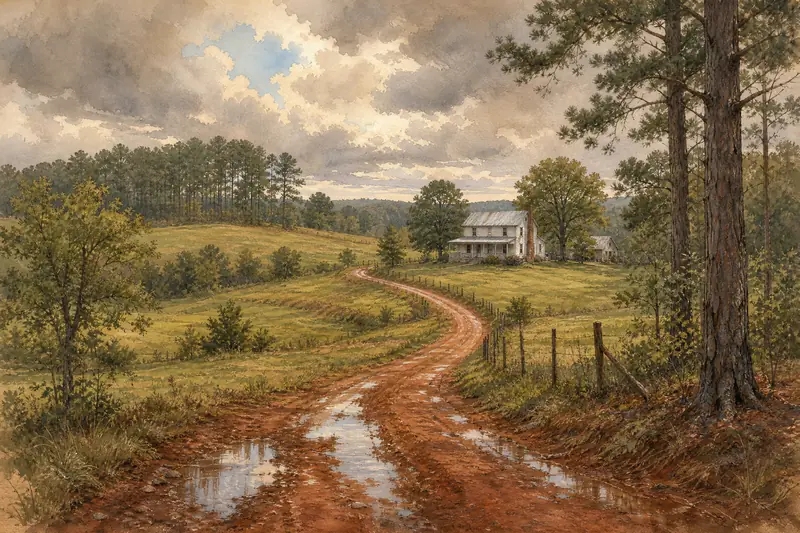
Three layers of the same lot
 SepticPumping, inspections, repairs, permits, and why red clay and Triassic soils make drainfields hard.
 WellsCounty testing, NC well rules, and iron, manganese, low pH, radon, uranium, arsenic and bacteria.
 City waterA short look at City of Durham water and what moving a septic home onto sewer takes.
The short version
- North Carolina septic permits follow 15A NCAC 18E, which caps clay soils at 0.4 gallons a day per square foot of trench, half or less of what sand may take.
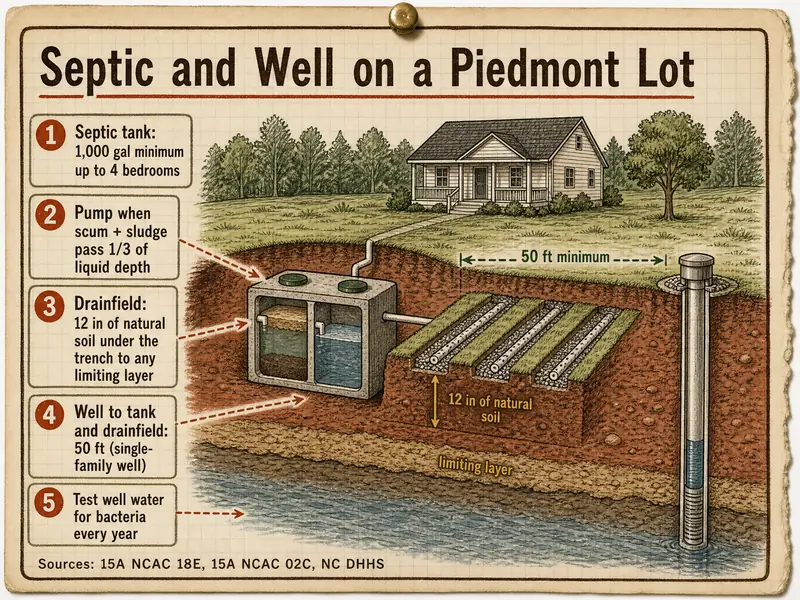
- A septic tank needs pumping once scum and sludge pass one-third of its liquid depth, typically every 3 to 5 years for a family on 1,000 gallons.
- New private wells must be sampled within 30 days under 15A NCAC 18A .3802, for coliform bacteria, 17 named chemicals and pH listed in .3803; uranium is not on that list.
- NCDHHS suggests testing well water for bacteria every year and for metals, nitrate and nitrite every two years.
- Durham County Environmental Health and Granville-Vance Public Health, plus the Orange, Chatham and Person health departments, issue septic and well permits; this site is not one of them.
- City of Durham water, about 24-25 mg/L hardness in the 2022 report (2022 data), counts as soft by the USGS yardstick (0-60 mg/L) and "slightly hard" by the 1-3.5 gpg band treatment guides apply; either way a softener is unnecessary on city water.
- 50 ftMinimum gap from a one-house private well to its septic tank and drainfield15A NCAC 18E Table IX
- 30 daysWindow for the county to sample a newly completed well15A NCAC 18A .3802
- 24%Share of Piedmont wells over the 0.05 mg/L aesthetic line for manganeseNCDHHS private well manganese guide
- About 90%Groundwater samples in a USGS study above 300 pCi/L radonUSGS SIR 2013-5072
Why does red clay decide how a Durham septic system works?
Red clay takes in septic effluent slowly, so a drainfield on Durham-area clay must be large and has little room for abuse. 18E Table XVII lets clay take 0.1-0.4 gallons daily per square foot and sand 0.8-1.2, so a three-bedroom house can need several times more trench on clay than on a sandy lot.
The ground has two other habits that matter. Piedmont rock weathers into saprolite, which can carry a drainfield only with 24 inches of separation and county pits, and clay holds water after rain, which is why NCDHHS lists slow drains after rain among the first signs of trouble. In the Triassic Basin, which the NC Geological Survey maps across parts of Durham, Granville, Orange and Chatham counties, many sites perform poorly for drainfields.
People still call the site test a perc test, but NC uses a soil and site evaluation that looks at texture, structure, wetness and depth. The red clay soil page and the Triassic Basin soils page explain what those findings mean, and the septic section lists every septic page on this site.
How often does a septic tank around Durham need pumping?
Most family tanks around Durham need pumping every 3 to 5 years, but North Carolina's real trigger is depth: a full pump-out once scum and sludge exceed one-third of the liquid in any compartment, under 18E .1303. NCDHHS, EPA and NC State Extension all give the same 3-to-5-year range for a typical household.
Household size moves the number a lot. Extension's table shows one person on a 1,000-gallon tank going about 12 years and eight people needing a pump-out every year.
A measurement every one to three years, written down, beats guessing. The septic tank pumping page explains the rule, what a pumper checks, and how to find the tank from the county permit.
What turns up in private wells in the five counties?
The usual findings in Durham-area wells are iron, manganese, low pH, radon and, in some rock types, arsenic or uranium, plus bacteria in any poorly sealed well. NCDHHS names lead, arsenic, iron, manganese, low pH and bacteria as common problems in the state's wells, and the rock under each lot sets which of those to expect.
NCDHHS reports Piedmont counties had the state's highest average manganese, with roughly a quarter (24 percent) of their wells over the 0.05 mg/L aesthetic line; the 0.3 mg/L health advisory is a separate, higher line. A USGS study of Piedmont and basin aquifers found about 90 percent of samples above 300 pCi/L radon, a level EPA proposed in 1999 but never finalized. NC DEQ notes the Carolina Slate Belt has more wells with detectable arsenic than other regions.
New wells get one required test. Under 15A NCAC 18A .3802, the county samples a new well within 30 days, and .3803 sets the list: coliform bacteria, 17 named chemicals (metals, nitrate and nitrite among them) and pH; uranium and radon are not on it. After that, testing is up to the owner, and NCDHHS suggests bacteria yearly and metals every two years. The well water testing page covers county lab fees, and the private wells section links the pages on iron and manganese, radon and uranium and arsenic.
| County | Health office | Residential septic Improvement Permit | Well bacteria test |
|---|---|---|---|
| Durham | Durham County Public Health, Environmental Health | $250 | $135 |
| Granville | Granville-Vance Public Health | $400 (conventional) or $450 (pump, LPP) | $75 |
| Orange | Orange County Health Department | $1 per gal/day, $360 minimum | $128.90 |
| Chatham | Chatham County Public Health | $250 (3 bedrooms or fewer) | $70 |
| Person | Person County Health Department | $200 (under 600 gal/day) | Fee not confirmed |
Which county office handles septic and well permits?
Whichever county the lot is in, its health department handles both septic and well permits, and none of them is this site. In Durham County that is the On-Site Water Protection section of Durham County Public Health, which does site evaluations, construction inspections, well water testing and complaint investigations.
Granville County is served by Granville-Vance Public Health, a district health department that issues septic and well permits after site and soil evaluations. Orange, Chatham and Person counties each run their own Environmental Health division. Under 15A NCAC 02C, no one may drill a private drinking water well without a county permit, and the county must issue a Certificate of Completion before the well goes into service.
The county permits and records page compares them, and the well permits page covers drilling rules.
What about homes on City of Durham water?
City of Durham water is chloraminated surface water drawn mainly from Lake Michie and the Little River Reservoir, backed by Jordan Lake and Teer Quarry. The City's 2022 water quality report (2022 data) lists hardness at 24 to 25 mg/L, about 1.4 to 1.5 grains per gallon. The USGS calls anything from 0 to 60 mg/L soft, while water-treatment guides, which grade in grains, file 1 to 3.5 gpg under "slightly hard." On both readings, households on city water can skip a softener.
The City has used chloramine since 2002, with a few weeks of chlorine-only treatment most springs. Its PFAS page reports PFOA at 2.4 to 5.5 parts per trillion and PFOS at 3.7 to 9.2 for tests from February 2018 to February 2025, some above EPA's 4.0 ppt limits that take effect in 2029; EPA has proposed allowing until 2031, which is not final. The City water section explains the report, and the septic to sewer page covers what switching takes for a septic home near the city line.
Where this comes from
Red Clay Septic & Well summarizes state rules (15A NCAC 18E, 02C and 18A), NCDHHS and NC State Extension guidance, NC Geological Survey and USGS reports, EPA standards, county health department pages, and City of Durham water reports, checked October 2026. City figures come from the 2022 and 2023 annual reports and the City's PFAS page, each named with its data year. Contractor prices, product claims and anecdotes are left out.
Questions worth asking
Is Red Clay Septic & Well a septic company or a county office?
Neither. It is a homeowner reference on septic systems and private wells around Durham. Permits come from the county health departments, work is done by certified contractors and inspectors, and this site has no tie to the business that once used this address.
How close can a well be to a septic system in North Carolina?
Under current rules, 50 feet from a septic tank and drainfield for a well serving one house, and 100 feet for public or shared wells and some saprolite systems. Permits written under older rules may show 100 feet.
Do private wells near Durham need to be tested after the first test?
No law requires it, but NCDHHS suggests bacteria every year; lead, copper, other metals, nitrate and nitrite on a two-year cycle; and pesticides and VOCs every five. Radon and uranium need to be asked for separately.
Is the Triassic Basin a problem for wells too?
It can be. NC Geological Survey says Triassic rock usually yields little water and plenty of wells there have come up dry, while diabase dikes in the basin make better drilling targets.
Does a home need both a septic and a well permit from the same office?
Yes. In all five counties covered here, environmental health staff at the county health department, or the Granville-Vance district for Granville, issue both septic permits and private well permits. This site is not one of those offices. The county permits page lists each office's posted fees.
Where do Durham homeowners get old septic and well records?
From Durham County Environmental Health, which sends copies of permits on file to anyone who asks with the site address and parcel number or PIN.